
Working with AI – Tools, Prompts, and Productivity
Location: Online
Date: Thursday, 19 March 2026
Time: 12:00-13:00
Price: £15.00+VAT for AHEP ‘Associate’, ‘Member’, ‘Accredited’ and ‘Fellow’ with a charge of £30.00+VAT for Intro to AHEP and non-members.
This event is part of a wider series with Martha Horler, the Data Goddess and AHEP Consultant. Check out the events page for more information.

About this session
This session is part of the wider ‘AI Literacy’ webinar series, check out some of the subjects covered in future sessions here and join us as a member to receive free access!
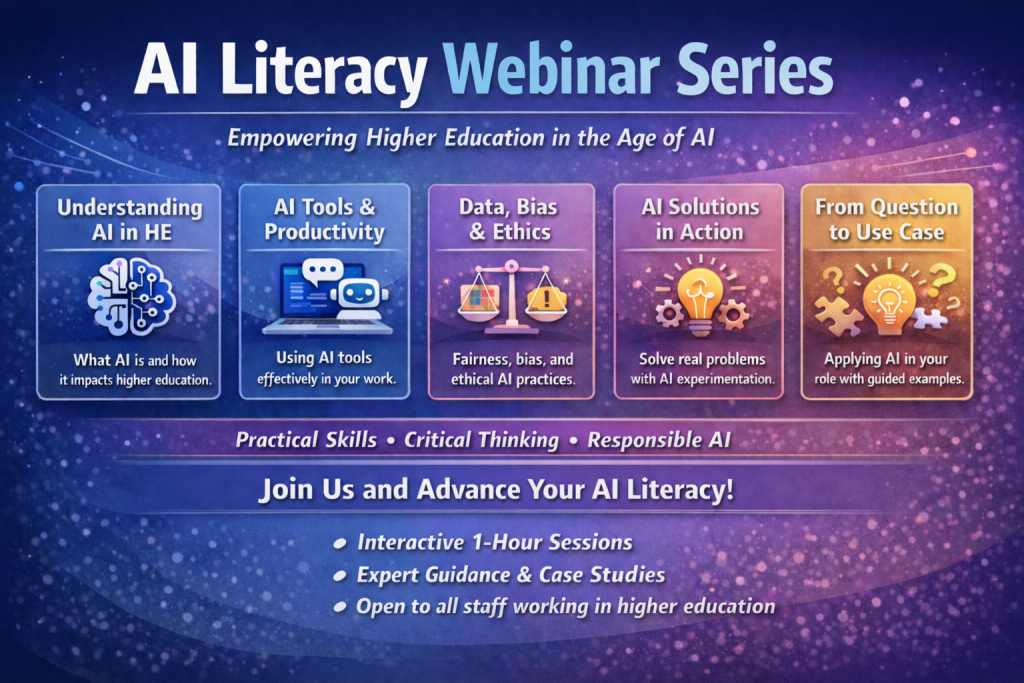
Artificial intelligence is increasingly present in higher education, but many staff are unsure what AI actually is, how it is being used, and what this means for their role.
This session builds practical AI skills by focusing on how to work productively with AI tools such as ChatGPT and Microsoft Copilot in realistic higher education contexts. You will learn how to structure effective prompts, refine AI outputs, and use AI as a support for thinking, drafting, and problem-solving rather than as a replacement for professional judgement.
Through live demonstrations and examples, the session will explore common workplace tasks such as drafting communications, summarising information, structuring documents, and supporting planning or analysis. Attention will also be given to the limitations of AI outputs, including accuracy, bias, and the need for verification, helping you develop safe and responsible working practices.
The session is designed to move you from tentative experimentation to more confident, informed use of AI tools in your day-to-day work, while maintaining professional standards and accountability.
Why attend?
Learn practical techniques for using AI tools effectively in everyday HE work
Develop confidence in writing and refining prompts to improve AI outputs
Understand the limits of AI tools and how to verify and sense-check results
Who is this session suitable for:
This session is aimed at higher education professionals who have a basic awareness of AI and want to develop practical skills for using AI tools in their work. It is particularly relevant to professional services staff, academic leaders, and managers who are beginning to experiment with AI and want to do so responsibly.
What you will do in the session:
You will be engaged through live demonstrations of AI tools, guided walkthroughs of prompt examples, and short reflective activities. You will be encouraged to think about how the examples relate to your own roles and to consider where AI could, and could not, add value in your work.
Learning Outcomes
By the end of the workshop, delegates will be able to:
1. Use structured prompting techniques to improve the quality and relevance of AI outputs
2. Apply AI tools to common higher education work tasks in a productive and responsible way
3. Evaluate AI-generated outputs critically, recognising accuracy issues, bias, and the need for verification
How does this session align with the AHEP Professional Framework?
1. Empowering Professional Development
This session supports the development of practical digital capability by helping delegates build confidence and skill in using AI tools effectively within their professional roles.
2. Demonstrating Responsible Practice and Personal Integrity
The session emphasises critical evaluation, verification, and ethical use of AI outputs, reinforcing the importance of accountability and professional judgement when using emerging technologies.
We look forward to welcoming you to this event.
Speaker

Martha Horler
The Data Goddess and AHEP Lead Consultant
About Martha
Martha Horler is a data and AI consultant with extensive experience working across higher education, supporting institutions to use data responsibly, effectively, and ethically. Her work focuses on data strategy, AI literacy, governance, and capability-building for professional services and leadership teams.
Martha has worked with a wide range of higher education providers and sector bodies, delivering training, workshops, and advisory support on data-informed decision-making, AI readiness, and digital change. She brings a practical, non-technical approach to AI, grounded in real institutional contexts and an understanding of the challenges faced by higher education professionals.